Modern Spanish Interior Design: A Hacienda Decor Guide
October 27, 2026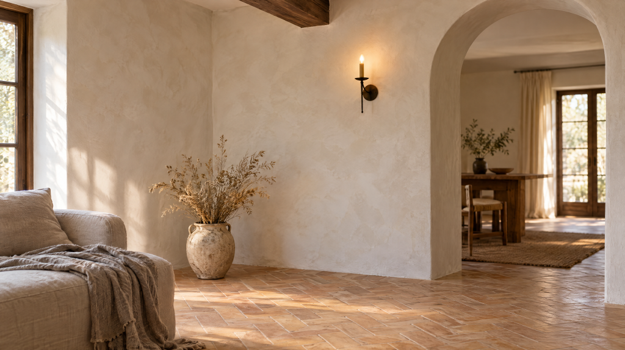
Modern Spanish interior design uses the same materials as a traditional Spanish hacienda: terracotta floors, white plaster walls, dark wood, black iron, and handmade tile. The modern version uses lighter colors, simpler furniture, and less pattern than a traditional hacienda. That restraint keeps the room warm and recognizably Spanish without making it look themed.
Tile is the hardest part of the look to change later, so two tile choices matter most: what goes on the floor, and where the patterned tile goes. Real terracotta suits rooms that stay mostly dry. It needs a sealer that you renew regularly, because unsealed clay soaks up stains. Terracotta-look porcelain absorbs almost no water, so it suits kitchens and bathrooms.
For patterned tile, we suggest one spot per room, such as a kitchen backsplash, a fireplace surround, or the stair risers (the vertical faces of the steps). Our advice on floors and pattern comes from 78 years of selling tile and stone at Bedrosians Tile & Stone, a family-owned company.
What makes a room look Spanish?
A room looks Spanish when it combines terracotta floors, white plaster walls, exposed dark wood beams, arched or open doorways, wrought iron, and handmade tile in a warm palette of terracotta, ochre, brown, and warm white. Much of that tile is patterned, and its geometric designs trace back to Moorish and Islamic art.
How modern Spanish style differs from the traditional hacienda look
A traditional hacienda interior layers deep earth colors, dark wood, carved furniture, and ornate detail in the same room. The modern version picks one or two of those as the focus and keeps everything around them plain and light.
Element | Traditional hacienda | Modern Spanish
|
Color | Terracotta, ochre, deep reds, and browns | Earthy neutrals, warm white, and sandy beige, with a few brighter accents |
Walls | Whitewashed plaster or smooth stucco | Plaster, or limewash (a paint made from crushed limestone, pigment, and water that gives walls a soft, cloud-like texture), in white or an earth tone |
Ceilings and wood | Dark wood planks and rafters, often on pitched ceilings with beams | Mid-tone to dark wood and simpler beams; some owners paint an existing dark wood ceiling white |
Floors | Terracotta, handmade tile, or wood | Terracotta laid in herringbone, handmade brick, or stone. For people who don't want a terracotta floor, designer Kate O'Hara suggests tiling the stair risers instead, so the Spanish tile shows on the steps rather than across the floor |
Pattern | Hand-painted tile in patterned designs | Moorish shapes such as arabesque tile (curved, lantern-shaped tiles that interlock), checkerboard, or thin tiles stacked in straight lines |
Iron | Ornamental ironwork with hand-forged scrolls | Iron in stair rails, lighting, and hardware |
Furniture | Carved wood and larger-scale seating | Simple, straight-lined wood pieces, leather, and linen, with sofas and window treatments kept neutral |
Fireplace | Often set in a corner | A simpler, straight-lined shape |
Lighting | Vintage and wrought iron statement fixtures | Large woven fixtures, plus warm light from wall sconces, table lamps, and candles |
The modern version also keeps the room from looking themed. A room with a terracotta floor, white walls, and one patterned backsplash looks Spanish. A room where every surface, light fixture, and accessory is Spanish starts to look staged, like a theme restaurant instead of a home. Comfortable, everyday furniture keeps a room from looking that way, because a room furnished for daily use looks like a home rather than a display. Mollie Ranize, founder of Dmar Interiors, told Homes & Gardens that "bringing in pieces that are comfortable and functional is key."
How is modern Spanish different from Spanish Colonial, Spanish Revival, Mission, and Mediterranean style?
Spanish Colonial, Spanish Revival, Mission, and Mediterranean are historical building styles. Modern Spanish is a current way of decorating that borrows materials from them. Spanish Colonial is the original style, brought from Spain during the colonial period. Spanish Revival, Mission Revival, and Mediterranean Revival are American styles from the late 1800s and early 1900s that revived older Spanish and Mediterranean building traditions.
Style | What it looks like | What to borrow for a modern room
|
Whitewashed plaster walls, ceilings of dark wood planks and rafters, and some ornate detail | White plaster walls and dark wood overhead | |
Spanish Colonial Revival, often called Spanish Revival | The most decorative of the revivals, with carved detail, wrought iron, and white or light walls | Black iron and one decorative tile feature |
Plain shapes modeled on the old Spanish missions, with very little ornament | Plain walls and only a few decorative pieces |
Mediterranean Revival isn't in the table because it is described almost entirely by its exteriors, so it offers little to borrow for a room. The City of Los Angeles describes it in its historic resources survey as a more formal, symmetrical relative of Spanish Colonial Revival.
Saltillo, terracotta, or terracotta-look porcelain: which floor should you choose?
Real terracotta gives you the handmade clay surface the style is known for. It also needs sealing and more care than most floors. Terracotta-look porcelain gives you the same color with much less upkeep. Because porcelain absorbs almost no water, it also holds up better in kitchens, bathrooms, and outdoor spaces. The right choice depends on the room, your climate, and how much maintenance you're willing to do.
Saltillo tile is a type of terracotta made in and around Saltillo, in Mexico's Coahuila state. The Taos News describes it as clay that is hand-molded, dried in the sun, and fired in kilns. The color shifts from yellow to deep orange from one tile to the next, depending on where each tile sat in the kiln.
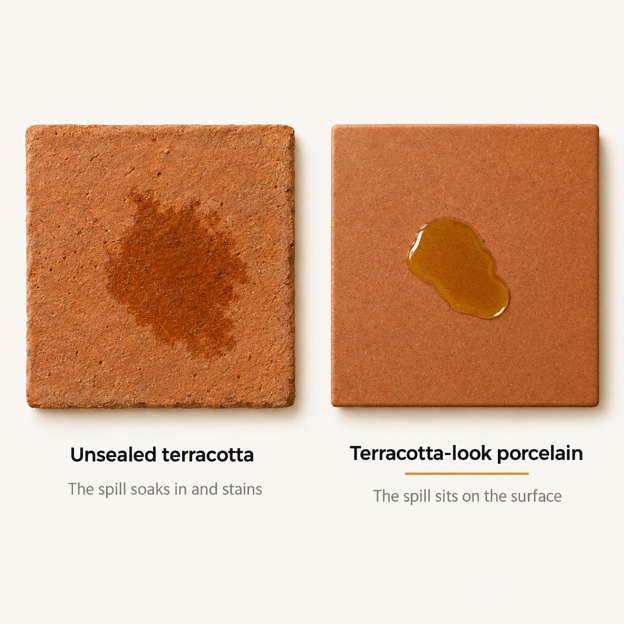
The biggest practical difference between clay and porcelain is how much water each one soaks up. Handmade clay pavers fall into the tile industry's most absorbent category, taking in more than 7% water, according to the Journal of Light Construction. Porcelain, by definition, absorbs 0.5% or less, per the Tile Council of North America. In everyday terms, a spill of wine or oil can soak into unprotected terracotta and leave a stain, while on porcelain it sits on the surface until you wipe it up.
Real terracotta or Saltillo | Terracotta-look porcelain
| |
What it is | Unglazed, handmade clay | Dense porcelain made in clay colors |
Water absorption | More than 7% | 0.5% or less |
Sealing | Needs a penetrating sealer, which soaks into the clay, plus periodic resealing | Doesn't need the regular resealing terracotta does, because it absorbs so little; check your product's care sheet |
Everyday care | Can stain once the sealer wears thin | Durable and water-resistant |
Slip when wet | Handmade clay may not come with a DCOF number. How much it grips depends on the clay's surface and the sealer on it | Rated product by product with a DCOF number |
Outdoors | Warm climates only; freezing winters can damage it | Many products are rated for outdoors. Where winters freeze, choose one rated for freeze-thaw |
Underfoot | Hard and cool underfoot, which helps in hot climates | Also hard underfoot. It conducts heat well, so it pairs with radiant floor heating if you want a warm floor |
DCOF (dynamic coefficient of friction) is the number that measures how much grip a tile has when it's wet. The industry standard calls for 0.42 or higher on level indoor floors that are expected to get wet. You'll find the number on a tile's spec sheet. Our guide to understanding DCOF explains how to use it.
On Berkeley Parents Network, one parent wrote, "I've had Saltillo tiles in my kitchen for about 25 years and none of them have cracked," though the same parent found them "difficult to keep clean." Another parent in the thread said the tiles are "very slippery when wet" and "very, very cold in the winter, we have to wear socks or slippers at all times."
Which floor suits you depends on how you'll use the room:
· Choose real terracotta or Saltillo if you want the real handmade surface and are comfortable resealing it. It fits best in rooms that stay mostly dry, like living rooms, dining rooms, and bedrooms. Deborah Houston Interiors argues for the real material in Redfin: "The key to any good design, particularly Spanish Hacienda, is to focus on authentic materials."
· Choose terracotta-look porcelain for kitchens, bathrooms, mudrooms, and busy entries. It also suits anyone who would rather not strip and reseal a floor on a regular schedule. It won't have the irregular surface of hand-molded clay, so compare a sample against real terracotta before you decide.
Our Cotto Nature porcelain tile is a 14×14 terracotta-look floor tile, and you'll find more options on our floor tile page.
How to make a terracotta floor look modern
A terracotta floor looks more modern with a newer layout, a lighter clay color, or brick in place of square tiles. These choices work whether you pick real clay or porcelain:
· Lay it in herringbone. Rectangular tiles set in a zigzag look newer than the traditional square grid.
· Pick from the lighter end of clay's color range. A pale, yellow-toned terracotta looks softer next to white walls than a deep orange one.
· Consider handmade brick. Brick is also fired clay, so it keeps the earthy color, but its long, narrow shape looks less traditional than square pavers. In a hacienda-style renovation of a 1962 Los Angeles house, Carlos Naude and Whitney Brown of Working Holiday Studio used handmade brick made in Tijuana, according to Dezeen.
Does terracotta tile need to be sealed?
Real terracotta and Saltillo tile need to be sealed, because unsealed clay soaks up spills and stains. We recommend a penetrating sealer rather than one that forms a film on the surface. Before you reseal, strip off the old sealer so the new coat can soak in.
The sealer you choose also changes how the floor looks and where it works:
· Water-based "natural look" sealer keeps the tile's original color.
· Solvent-based "wet look" sealer adds gloss. It can also hold moisture in the tile, so it's a poor fit for damp rooms like bathrooms.
· Latex sealer shouldn't go in damp areas at all. Tile contractor Michael Byrne writes in the Journal of Light Construction that when he has seen Saltillo floors turn hazy or milky, the cause was a latex sealer exposed to damp.
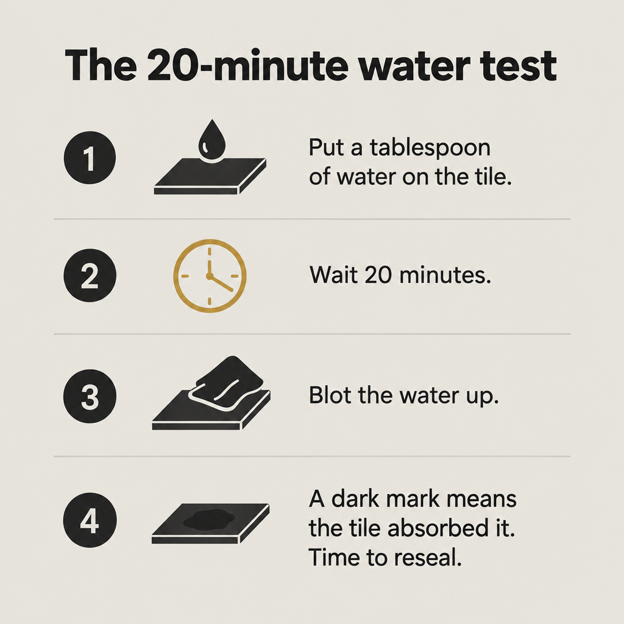
How often to reseal depends on the sealer and how much foot traffic the floor gets. Drytreat, one of the sealer makers we work with, says its water-based penetrating sealer lasts one to three years. To check whether your floor is due, Drytreat suggests a water test:
1. Put a tablespoon of water on the tile.
2. Wait 20 minutes.
3. Blot the water up.
4. If the water left a dark mark, the tile absorbed it, and the floor is ready to be resealed.
We carry Drytreat and Miracle Sealants sealers, so you can ask about them at your nearest showroom. For routine cleaning, see How To Clean Each Type of Tile Floor & Grout.
Where to use patterned Spanish tile
Patterned tile works best in a few small spots: a kitchen backsplash, stair risers, a bathroom floor, or a fireplace surround. Each one has a clear edge where the pattern stops, so the pattern looks planned rather than scattered.
One kind of patterned tile you can use in these spots is encaustic, meaning the pattern is made from colored material pressed into the tile rather than painted on top. Real encaustic cement tile is pressed from layers of pigmented cement and never fired, so it's porous. Installers seal it several times before grouting so the grout doesn't stain it, according to TileLetter. After that, you clean it with a pH-neutral cleaner and never an acid cleaner.
Ceramic encaustic looks, such as our Casablanca ceramic tile, skip that repeated sealing, because ceramic tile is typically glazed for color and protection. Our Encaustic Look page includes repeat patterns in clay, cement, and ceramic, so check which material each tile is before you plan its care.
Kitchen backsplash
A backsplash is the easiest place to start with pattern, because it's a small area and it's already the focal wall of most kitchens. Three kinds of tile suit a Spanish kitchen:
· Arabesque tile. Because the tiles interlock into a Moorish pattern, the shape makes the pattern even in a single color. Kristen Fiore of Kristen Elizabeth Design suggests Moorish tile shapes for backsplashes in Homes & Gardens. See our arabesque tile page.
· Encaustic-look tile. The pattern is pressed or printed into each tile. Casablanca is a 5×5 encaustic look with Mediterranean and Moroccan motifs.
· Zellige. Zellige is handmade Moroccan tile with irregular edges, a glossy surface, and color that varies from tile to tile. Our article What Is Zellige Tile and Why Do Designers Love It? explains more. Our Zagora zellige-style ceramic tile comes in 2×2, 4×4, 2×6, and subway sizes, and you'll find more on our zellige page.
You'll find more options on our backsplash tile page.
Stair risers
Kate O'Hara of Martha O'Hara Interiors told Redfin, "For people who don't want terracotta covering their floors, they might consider stair risers, which is a beautiful and unique way to pull the necessary elements into a house."
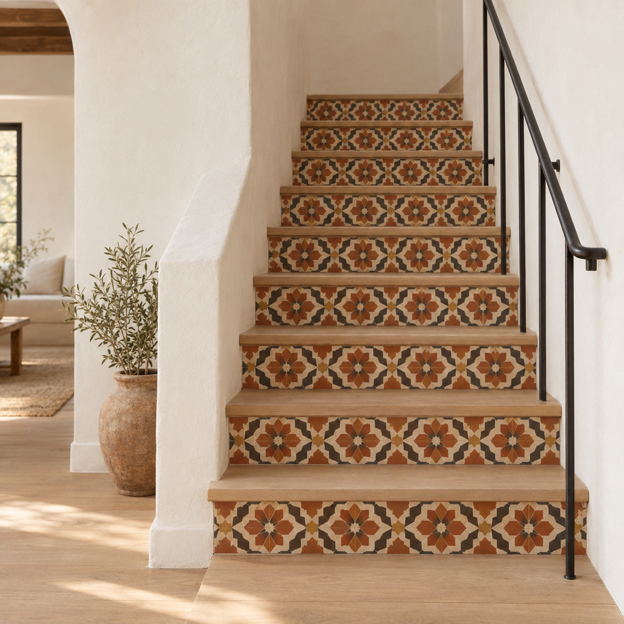
Measure your risers before you choose a tile. The International Residential Code, a model building code that many local governments adopt, limits risers to 7 3/4 inches, per this City of Boise code handout. Older homes and local codes can differ. Under that limit, a tile 8 inches or taller will usually cover a riser in one row, with the extra trimmed off. Trimming cuts off part of the pattern, so choose a design that still looks complete with its top or bottom edge cut away.
Bathroom floor
A patterned bathroom floor works well when the walls stay plain. If the pattern continues into a shower, choose small tiles or a mosaic with a DCOF rating for wet floors. The extra grout lines give your feet more grip. For a fuller bathroom plan in a related style, see How to Create a Mediterranean-Inspired Bathroom with Tile.
Fireplace surround
A fireplace surround is one of the most common places to show off patterned tile, because it's already the focus of the room. The tile covers the area around the opening and the hearth, so it needs to handle heat. Porcelain, ceramic, and natural stone all qualify. Our post We Hearth Tile: Six Ideas for A Fireplace You'll Love includes a Casablanca surround.
How much patterned tile is too much?
Pattern starts to look like too much when two patterns compete in the same view. We suggest one patterned surface per room. Surround the patterned area with plain tile on the same floor or wall. Keep the walls and fixtures nearby simple as well. If you can see two patterned areas at once, such as tiled stair risers from the kitchen, choose patterns that share a color so they look related. A wider range of options is on our decorative tiles page.
What colors go with modern Spanish style?
Modern Spanish style works best with warm white or sandy beige walls, terracotta as the main warm tone, and one or two earthy accent colors.
Where | Color | Why it works
|
Walls and cabinets | Warm white or sandy beige | A warm white leans slightly yellow rather than blue, so it sits comfortably next to orange-red terracotta |
Floors | Terracotta, or a terracotta-look tile | It works as a background color, the way beige or gray does, so the accent colors stand out against it instead of clashing |
Accents | Earthy brown, blue, gold, or green | These belong on smaller surfaces like a patterned backsplash, cushions, pottery, or a single painted door |
Those accents come from interior designer Thomas Callaway, who describes "strong, simple earth colors like brown, blue, gold, and green" set against a white or neutral backdrop in Homes & Gardens.
How to handle plaster walls, beams, arches, and iron
Spanish architectural details can be kept simple in a modern room:
· Walls. Limewash can go on ordinary drywall, so you don't need plaster walls to use it. Prime the drywall first with the primer the limewash maker recommends.
· Beams. If your house has wood beams, keep them. In a modern room the beams can be plain, square timbers rather than heavy, carved ones.
· Arches. An arch is the classic shape, but a wide, open doorway between rooms gives a similar sense of flow if your house doesn't have arches.
· Iron. Custom wrought iron is less common today because of the time and cost to make it. Black iron light fixtures, cabinet hardware, and stair rails bring in the same look.
How to get the modern Spanish look without a remodel
You can bring in the modern Spanish look with paint, a few small tile projects, and decor, without moving any walls:
· Limewash one wall in warm white or an earth tone.
· Tile the stair risers with a patterned tile.
· Replace the backsplash with a patterned or handmade-look tile.
· Retile the fireplace surround.
· Swap light fixtures and hardware for black iron.
· Add flatweave rugs. Christine Markatos Lowe, founder of Markatos Design, told Homes & Gardens she starts with vintage lighting and flatweave rugs.
· Display a few pieces of handmade pottery rather than filling every shelf.
· Bring in linen and leather through cushions, throws, and upholstery.
· Hang art by craftspeople, mixing vintage and current work.
If your house is already Spanish style, work with what's there. In a Spanish-style house featured in Sunset, designer Genna Margolis of Shapeside painted the original dark wood ceiling white. "The goal was to make it modern, but keep the integrity of the Spanish style home," she said.
What goes in a Spanish-style courtyard or patio?
If your indoor floor is terracotta or a terracotta-look tile, we suggest an outdoor tile in the same color for a courtyard or patio, so the two spaces look connected. Check four things before you choose an outdoor tile:
· It's rated for outdoor use. You'll find outdoor-rated options on our outdoor tile and pavers pages, including frost-resistant tile.
· It survives your winters. Water that soaks into porous tile can freeze, expand, and break off the surface, so real terracotta works outside only where winters stay mild. Porcelain absorbs very little, but freeze-thaw resistance (how well a tile survives repeated freezing and thawing) still varies by product. Stone World advises reading the tile's spec sheet and asking the manufacturer to confirm in writing that the tile can handle freezing and thawing.
· It grips when wet. Some outdoor tile is rated on the R scale, which comes from a German slip test and runs from R9 to R13. A higher number means more grip. Our outdoor range includes tile rated R10 and R11.
· Real terracotta gets an exterior sealer. In warm climates where real terracotta works outside, use an exterior-rated sealer with UV protection.
See the tile in your own room before you choose
The easiest way to decide between real terracotta and a terracotta-look porcelain, or to settle on a backsplash pattern, is to see them in the room where they'll go. You can order tile samples online and set them on your floor and against your wall color in daylight and in the evening. If you'd like help choosing, visit one of our 44 showrooms across 11 states. Find the closest one at local.bedrosians.com, or call us at (559) 275-5000 and we'll connect you with the right showroom.
