Best Patio Materials for Cold Climates: Freeze-Thaw Guide
Best patio materials for cold climates and what to lay them on
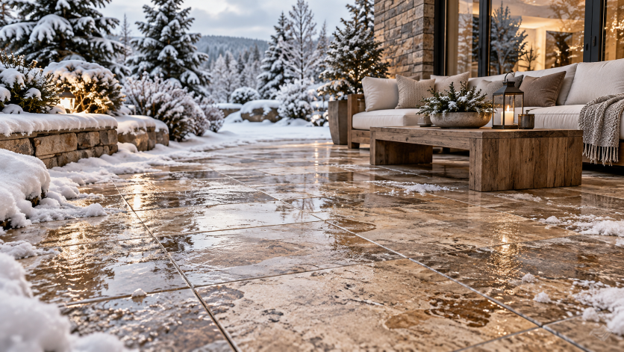
The best patio materials for cold climates are porcelain pavers, granite, and concrete pavers made for freezing climates. Porcelain and granite soak up very little water, and concrete pavers made for freezing climates are tested through repeated freezing and thawing. Water is what breaks a patio in winter, so a material that keeps water out has the least to fear from a hard freeze.
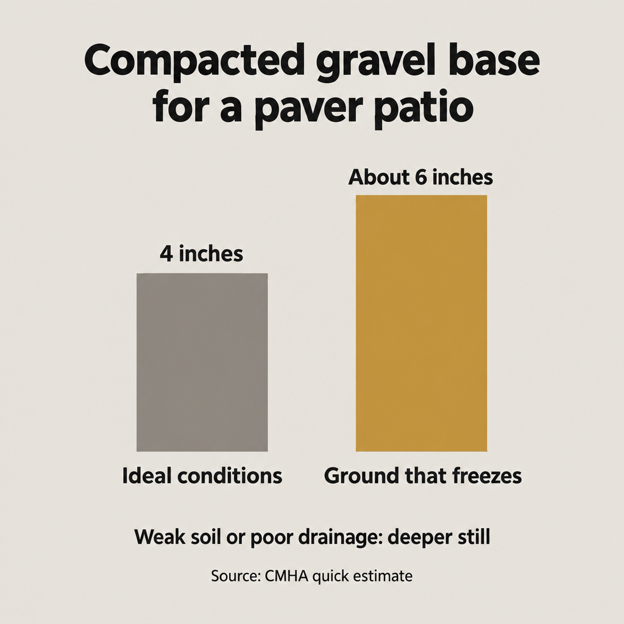
The gravel base under the patio matters just as much as the material. Water that collects under a patio can freeze and push it up, so the base has to drain. Where the ground freezes, plan on a base about 6 inches deep once it's packed down, by the concrete paver industry's rule of thumb.
Bedrosians Tile & Stone has supplied tile and stone since 1948. Many of our 44 showrooms across 11 states are in places with freezing winters, including Colorado, Utah, and Idaho. We sell porcelain and natural stone. We don't sell concrete pavers, poured concrete, or brick, so for those, the advice here comes from the standards and guidance their industries publish.
Patio materials compared for freezing winters
The first number to look at is water absorption: how much water a material soaks up, as a percentage of its own weight. The lower it is, the less water there is inside the material to freeze.
Material | How it handles freezing | Water absorption | How it's laid |
Porcelain pavers | Holds up well when rated by its maker for outdoor use in freezing climates | 0.5% or less | Pavers: on gravel, or on adjustable supports (pedestals) over a concrete slab. Thinner porcelain tile: set in mortar on a slab |
Granite | Holds up well, with a long record as outdoor paving | 0.05% to 0.40% | On gravel, or set in mortar on a slab |
Bluestone | Depends on the stone | Varies by stone: ask the supplier for the stone's absorption test result | On gravel, or set in mortar on a slab |
Slate and quartzite | Quartzite: absorbs little. Slate: depends on the stone | Quartzite: 1% or less. Slate: varies by stone, so ask the supplier for the stone's absorption test result | On gravel, or set in mortar on a slab |
Concrete pavers | Holds up well when made for freezing climates to the concrete paver standard, ASTM C936 | 5% or less on average, no paver over 7% | On compacted gravel with a layer of sand on top |
Poured and stamped concrete | Can last when mixed with tiny air bubbles that give freezing water room (air-entrained) | Ask your contractor for air-entrained concrete | Poured as one solid slab |
Clay brick pavers | Holds up when made in the severe weathering class | Varies by class: ask the brick maker for class SX, the severe weathering class | On gravel, or set in mortar on a slab |
Travertine, limestone, sandstone, and marble | Limestone and travertine: only a limited number have a record as outdoor paving where winters freeze. Marble: outdoor use mostly limited to white marbles. Sandstone: depends on the stone | Limestone and travertine: under 1% to over 10%. Others: ask the supplier for the stone's absorption test result | On gravel, or set in mortar on a slab |
If you're also weighing wood decking, composite decking, or loose gravel, ask the maker or your contractor how each one handles your winters. For prices on porcelain and natural stone, see our breakdown of how much outdoor tile costs.
Why do patios crack, heave, or flake in winter?
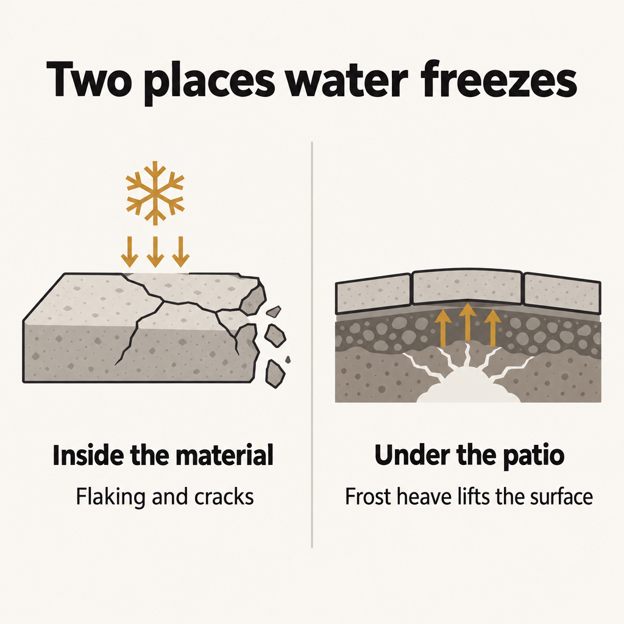
Patios crack, heave, and flake in winter because water freezes and expands, and it does that in two places: inside the material and underneath it. Frozen water takes up 9% more space than liquid water, according to a technical bulletin from the NIH Office of Research Facilities. Concrete, brick, and stone all have tiny pores that water can soak into. When that water freezes, it pushes on the material from inside, and each freeze and thaw opens the pores a little wider. The damage shows up as flaking on the surface or as cracks that start inside and work their way out.
Water under the patio does the same thing on a larger scale. If the ground or the base below the patio holds water and that water freezes, it lifts the surface from beneath. That lifting is called frost heave.
How does each patio material hold up in freezing weather?
Porcelain pavers
Porcelain handles freezing weather well because it absorbs very little water. The American standard for ceramic tile, ANSI A137.1, defines porcelain as tile that absorbs 0.5% or less of its weight in water. For a patio, choose porcelain that its maker rates for outdoor use in freezing climates or that has passed the tile industry's freeze-thaw test, ASTM C1026.
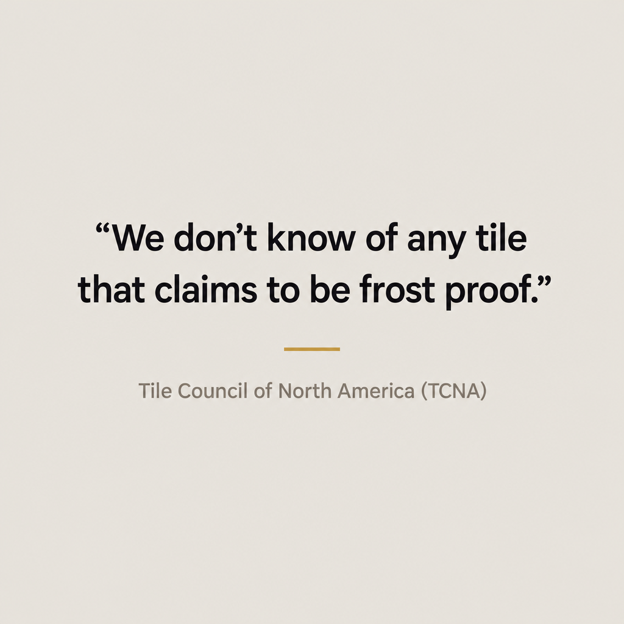
Low absorption doesn't make porcelain frost proof. "We don't know of any tile that claims to be frost proof," the Tile Council of North America (TCNA) writes. Tile rated for freezing can still be damaged when water seeps into grout joints or into gaps in the mortar underneath, or when water and ice sit on the surface. That makes the installation as important as the tile.
Porcelain pavers are thicker than porcelain floor tile. They're at least 20mm (0.79 inch) thick, which is why they're often called 2cm pavers, according to TileLetter. At that thickness, they can be laid on gravel without mortar, or set on pedestals, adjustable supports that hold the pavers above a concrete slab. Thinner porcelain tile is set in mortar on a slab. Our porcelain pavers include Poetry Stone porcelain pavers in 24 x 36 inches and Area 51 porcelain pavers in 24 x 48 inches. Check each product's thickness and recommended installation method before you plan the base. If you're still deciding between porcelain and natural stone, our comparison of natural stone vs. porcelain tile goes further into how the two handle cold.
Granite
Granite is a natural stone that absorbs about as little water as porcelain. The Natural Stone Institute (NSI) puts granite's absorption at 0.05% to 0.40%. NSI also notes that granite has a long history outdoors, both as paving and on the outside walls of buildings. It has a record with de-icers, too: in northern climates where snow-melting chemicals are used heavily, NSI says, "granite has resisted the attack." Granite is part of our natural stone tile range, along with slate, travertine, limestone, and marble.
Bluestone, slate, and quartzite
How much water bluestone and slate absorb varies from one stone to the next, so ask the supplier for the result of the specific stone's absorption test (ASTM C97). There's no ASTM freeze-thaw test for natural stone, according to an NSI course on stone testing. The course names the absorption test as one possible indicator of how a stone will do in cold, wet conditions. Compare the result with granite's 0.05% to 0.40% and porcelain's 0.5% or less.
Quartzite has a published figure: no more than 1% absorption. That limit applies to stone graded as quartzite under ASTM C616, the U.S. standard for quartz-based stone, as listed in a Cornell University stone masonry standard. Ask the supplier whether the quartzite you're considering is graded to ASTM C616.
Concrete pavers
Concrete pavers absorb more water than porcelain or granite, but pavers made for freezing climates to the industry standard, ASTM C936, are tested for freezing. Under that standard, pavers average no more than 5% absorption, and no single paver can go over 7%. Pavers meant for freezing climates also go through 50 freeze-thaw cycles in water or in a 3% salt solution, according to the guide specification from the Concrete Masonry and Hardscapes Association (CMHA). Ask whether the pavers you're considering meet C936 and are made for freezing conditions.
Because concrete pavers sit on gravel and sand rather than mortar, a paver that lifts or settles when the ground moves can be taken up and reset.
Poured and stamped concrete
A poured concrete patio, stamped or plain, can last through freezing winters when the concrete is mixed and cured for freezing weather. Without that, the surface is prone to scaling, which the National Ready Mixed Concrete Association (NRMCA) describes as "local flaking or peeling of a finished surface." For a patio that stays damp and gets ice melt, NRMCA recommends four things to ask your contractor for:
Air-entrained concrete. NRMCA says concrete that stays damp, freezes, and gets ice melt should be air-entrained.
6% air. The air bubbles should make up 6% of the concrete when the mix uses 3/4-inch or 1-inch stone (the gravel mixed into the concrete).
A strength of 4,000 psi.
Proper curing. After the pour, the contractor covers the new slab with a curing compound or wet burlap to keep it from drying out while it hardens.
A poured slab is one rigid piece, so it can't flex when the ground moves. If the ground under it heaves, the slab can crack. Unlike a paver, a cracked slab can't be lifted and reset. It has to be patched or replaced.
Clay brick pavers
Clay brick pavers can work in a cold climate if they're made for severe weathering. The standard for paving brick, ASTM C902, sorts brick into three classes by the weather it will face: SX, MX, and NX. In those names, "S indicates severe weathering," the Brick Industry Association notes. Class SX is the one to ask for anywhere your patio freezes.
Will marble or travertine pavers crack in winter?
Whether a marble or travertine paver survives freezing winters depends on the specific stone, because stones in these groups vary widely. NSI says absorption in the limestone group, which includes travertine, ranges from under 1% to over 10%. It also says only a limited number of limestones have a successful history as outdoor paving, "particularly in freeze/thaw environments." For marble, NSI says outdoor use is "generally limited to white marbles, with some exceptions."
If you love the look of one of these stones, ask the supplier whether that exact stone has been used outdoors where winters freeze.
Does the installation method matter for a cold-climate patio?
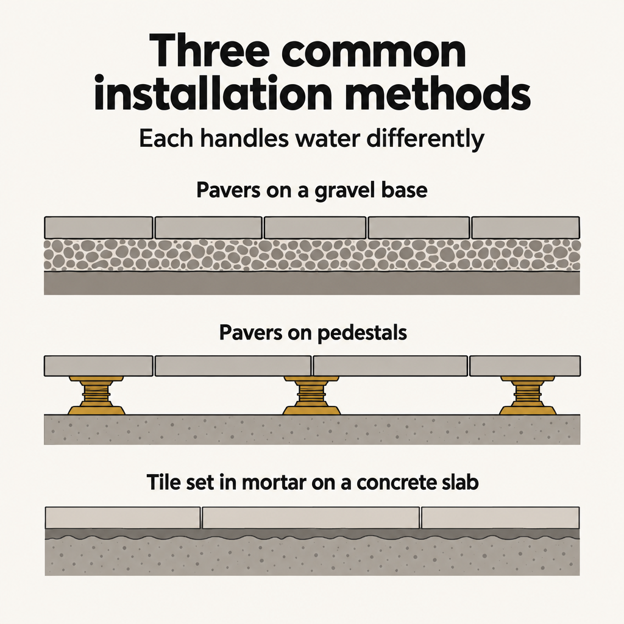
The installation method matters because it decides where water goes once it gets past the surface. Whatever you choose, the patio should slope away from the house so water runs off instead of sitting on or under it. Beyond that, the three common methods handle water differently.
Pavers on a gravel base. Concrete pavers, brick, stone, and 2cm porcelain pavers can all be laid on compacted gravel with no mortar. CMHA sets 4 inches of compacted base as the minimum for patios, but that figure assumes ideal conditions: strong soil, good drainage, and ground that doesn't freeze. CMHA's quick estimate adds about 50% to the base for each of those conditions your site doesn't meet. By that estimate, freezing ground alone takes the base from 4 inches to about 6. If your soil is also weak or drains poorly, the base needs to be deeper still. Your contractor can tell you how deep the ground freezes where you live and what your local building department requires.
Pavers on pedestals. 2cm porcelain pavers can sit on pedestals over a concrete slab, with open space underneath for water to drain. Nothing bonds the pavers to the slab, so there's no mortar for water to get into. TileLetter reports that pedestal systems have "less chance of freeze/thaw damage" when they're installed correctly. The slab underneath still needs to drain.
Tile set in mortar on a concrete slab. Porcelain tile or stone set in mortar on a slab can last through freezing winters when every detail keeps water out. The mortar should cover almost the whole back of each tile: TCNA says it's typically important to have "better than 95% mortar contact between the tile and the substrate," meaning the slab. Any gap left under a tile is a place for water to collect and freeze. TCNA also calls for mortar rated for outdoor use. And it calls for expansion joints, which let the tile move as temperatures and moisture change. The TCNA Handbook, as cited by Scott Carothers of the Ceramic Tile Education Foundation, gives the minimum slope as 1/4 inch per foot.
For step-by-step instructions, see our guide to installing outdoor porcelain tile.
What ice melt is safe for a patio?
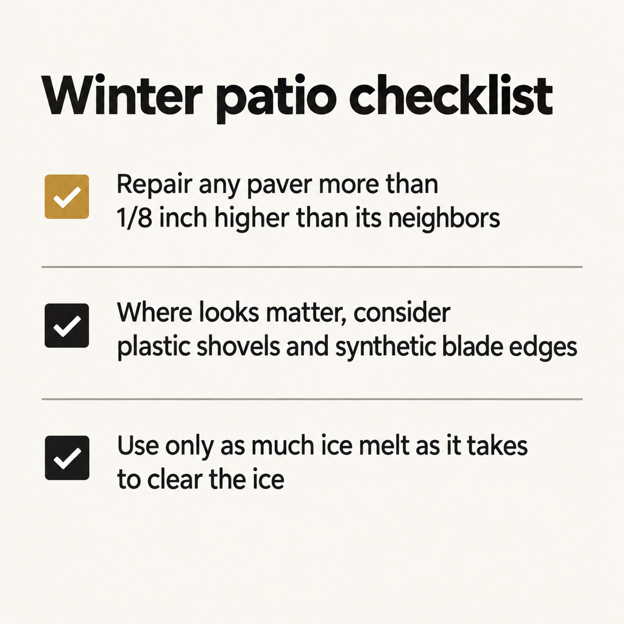
On any patio, use only as much ice melt as it takes to clear the ice. Beyond that, the right product depends on the material.
Patio material | What to use |
Concrete pavers | Rock salt, or calcium chloride used carefully when you need faster melting, per CMHA. Avoid magnesium chloride. |
New poured concrete | No ice melt in the first winter after the pour, then moderate amounts, according to NRMCA |
Porcelain | Salt used sparingly and swept up once the ice is gone |
Natural stone | Whatever the stone supplier or sealer maker recommends |
Clay brick pavers | Whatever the brick maker recommends |
For porcelain, we give the same advice as in our guide to caring for porcelain outdoors, because prolonged contact with rock salt can dull the surface or harm the grout.
For concrete, the experts disagree about which ice melt does the least harm. CMHA says in its maintenance guide that "Rock salt (sodium chloride, NaCl) is the least damaging to concrete materials and should be used whenever possible." It allows careful use of calcium chloride when you need faster melting. It advises against magnesium chloride and CMA (calcium magnesium acetate), which it says "can chemically degrade all types of concrete."
Utah State University Extension, writing about de-icers for sidewalks and driveways, takes nearly the opposite view. It says rock salt is "harmful to plants, soil, and concrete" and contributes to pitting. It calls calcium chloride and magnesium chloride "highly corrosive to concrete," so the calcium chloride CMHA allows is one Utah State warns against. And it suggests CMA as an alternative to rock salt that is "less corrosive to concrete."
For concrete, the safe course is the advice the sources share. Skip magnesium chloride, which both CMHA and Utah State warn against, and use as little ice melt as you can. On new poured concrete, use none in its first winter, as NRMCA advises.
If the look of your paver surface matters to you, CMHA's maintenance guide suggests considering plastic shovels, or snow blowers and plows with synthetic blade edges. The same guide advises repairing any paver that sits more than 1/8 inch higher than its neighbors before winter. As CMHA warns in its winter tips, "a raised edge could catch a shovel, snow blower, or snowplow."
Which patio surfaces are less slippery in snow and ice?
No slip rating measures how a patio surface behaves on ice, because slip tests are run on wet or oily surfaces. On ice, what matters on any patio is clearing snow and ice promptly. For rain and melting snow, three things are worth checking:
Finish. We don't recommend polished surfaces anywhere water collects, so for a patio, look at matte or textured finishes.
Exterior Wet rating. On a tile's product information, look for an Exterior Wet (EW) rating, which means the maker has classified the tile for level outdoor areas that get wet. You may also see a DCOF (dynamic coefficient of friction) figure, which measures how slippery tile is when wet. The tile standard sets its basic indoor ratings by DCOF, but it leaves the Exterior Wet rating to the maker, so for a patio, the EW rating is the one to look for. Our guide to DCOF explains the measurement.
R rating. Many outdoor tiles also carry an R rating from a German slip test, on a scale from R9 to R13. The higher the number, the more slip resistant the tile. Our outdoor porcelain includes tile rated R10 and R11, such as Sinai porcelain tile in 24 x 48 inches, rated R11.
Which patio materials need sealing?
We recommend sealing natural stone, and the grout joints on tile set in mortar are preferably sealed too. Sealer is an option on concrete pavers.
Natural stone. We recommend sealing natural stone to resist stains and moisture. Ask the supplier what your stone needs, and follow the sealer maker's directions for how often to reseal.
Tile set in mortar on a slab. TCNA says grout joints should be completely filled and packed tight, and preferably sealed with a vapor-permeable sealer, one that lets trapped moisture escape as vapor.
Concrete pavers. CMHA says sealers "reduce intrusion of water, stains, oils, and dirt into paver surfaces." Where white mineral deposits (efflorescence) are a concern, CMHA recommends a breathable sealer, one that lets moisture escape. Clean the pavers before sealing them. Reapply the sealer from time to time as it wears away with use and weather.
Most of our showrooms have a counter where contractors pick up sealers from Miracle Sealants and Drytreat, along with the mortar and grout used to set tile.
Cold-climate patio questions
Can pavers be installed in cold weather?
Concrete pavers can be installed in cold weather, but never on frozen ground. CMHA notes that pavers are cured before they leave the plant, so cold doesn't hurt the pavers themselves. The base and sand are the problem: CMHA says frozen base material shouldn't be installed or placed over frozen soil, and frozen or saturated sand shouldn't be used. Tile set in mortar needs warmer conditions. Most makers of dry-set mortar, a common mortar for tile, require a temperature of at least 40°F while the tile goes down and for 72 hours afterward, according to TileLetter. Check the instructions on the mortar you use.
What patio material lasts the longest?
How long a cold-climate patio lasts depends on how little water the material absorbs and how well it's installed. Of the materials in our table that give an absorption figure, granite and porcelain have the lowest upper limits: at most 0.40% for granite and at most 0.5% for porcelain. Concrete pavers made to ASTM C936 for freezing climates are tested for repeated freezing.
See outdoor porcelain and stone before you choose
If porcelain pavers or natural stone are on your list, order a few samples so you can see and hold them before you decide. Your first five samples of our tile and stone are free with code SHIPFREE5. You can also visit one of our 44 showrooms, where our team can walk you through outdoor-rated options and refer you to a local contractor for the installation. Or call us at (559) 275-5000, and we'll connect you with the showroom nearest you.
