Best Marble-Look Porcelain Tile Ideas for Kitchens and Bathrooms (2026)
September 16, 2026
Marble-look porcelain gives you the classic marble look, whether that is soft Carrara, dramatic Calacatta, crisp Statuario, or high-contrast Nero Marquina, in the two rooms that are hardest on natural stone: the kitchen and the bathroom. It resists the etching, staining, and constant sealing that come with real marble, and the best ideas fall into a few clear groups. Pick the marble look that matches the mood you want, then apply it as a large-format floor, a full-height slab backsplash, a waterfall island, a shower wall, or a mosaic accent.
At Bedrosians Tile & Stone, we design porcelain collections in-house at the affordable-luxury tier, with three to four new collections every quarter, and we have spent 78 years specifying tile for kitchens and bathrooms. That experience shapes the guidance below: which look suits which room, which finish belongs on a floor versus a wall, and why porcelain holds up where marble struggles.
One note on pricing before we start. Any cost figures in this guide are general market estimates. Actual prices vary by region, material and finish, site conditions, and project size. Use the ranges to plan a budget, then get a quote for numbers specific to your project.
Why marble-look porcelain works better in kitchens and bathrooms
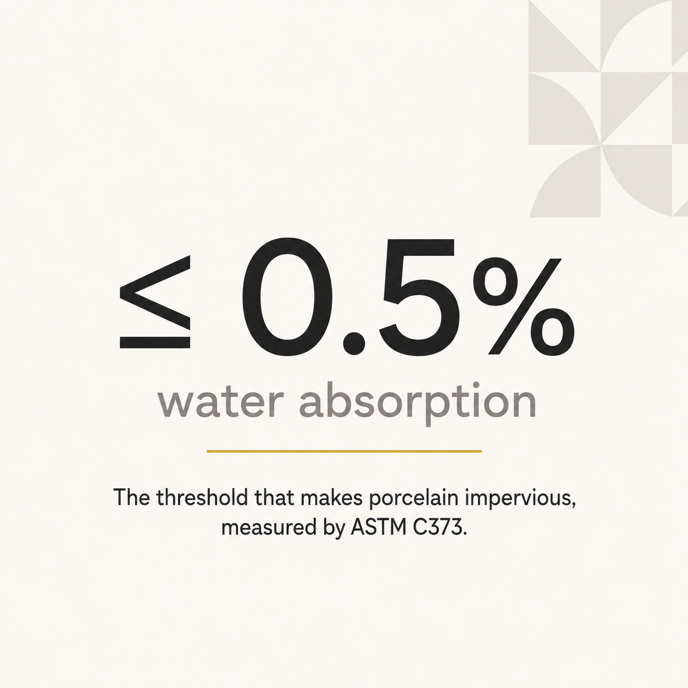
Industry standards define porcelain as tile with water absorption of 0.5% or less, measured using ASTM C373, which is why the Tile Council of North America classifies it as impervious. That low absorption is exactly what you want on a bathroom floor, a shower wall, or a kitchen surface that meets daily spills.
Natural marble behaves differently. Marble is calcium-carbonate based, so it reacts with acids. Architectural Digest notes that everyday kitchen liquids like lemon juice and vinegar can etch marble, and that sealing does not prevent that chemical etching. The Natural Stone Institute gives the same caution about acidic cleaners and calcareous stone. In a kitchen full of citrus and wine, and a bathroom full of personal-care products, that is a real maintenance concern that porcelain does not share in the same way.
Porcelain is also easier to live with day to day. Gauged porcelain panels and slabs generally do not require sealing and can be cleaned with mild soap and water. Marble usually needs a penetrating sealer as part of its care routine, and that sealer can wear off over time.
To keep the comparison honest, natural marble does have advantages porcelain cannot copy exactly. Every marble slab is geologically unique, so no two are identical, and worn marble can be sanded and repolished. For homeowners who value that authenticity and patina, marble is a genuine choice. Porcelain wins on practicality in wet, spill-prone, high-use rooms, which is the situation most kitchens and bathrooms are in.
Care issue | Marble-look porcelain | Natural marble |
Surface sealing | Generally not required | Penetrating sealer commonly recommended |
Acid etching | Does not share marble's acid reaction | Lemon, vinegar, and other acids can etch, even when sealed |
Daily cleaning | Routine mild soap and water, product dependent | Non-acidic, stone-safe cleaning only |
Grout care | Grout is a separate maintenance consideration | Grout plus stone maintenance |
Visual aging | Designed surface stays relatively consistent | Patina and etching may develop over time |
For a deeper side-by-side on upkeep and long-term cost, see our guide on porcelain versus natural stone.
The four marble looks and where each one fits

Most marble-look porcelain falls into one of four visual families. Choosing the look first makes every later decision easier.
Carrara look
Carrara is the softest and quietest of the group. That lower contrast makes Carrara-look porcelain the strongest choice for all-over treatments, where the design should read as marble without every surface becoming a focal point. It suits broad kitchen floors, full bathroom walls, restrained shower surrounds, and classic subway backsplashes. It is also the easiest look to pair with warm woods and colored cabinetry.
Calacatta look
Calacatta reads brighter and bolder, with a whiter field and more dramatic veining. In porcelain, that makes it the look for feature applications where a large area lets the pattern read: full-height backsplashes, waterfall islands, large shower panels, and bathroom feature walls. Think of Calacatta as higher visual drama and Carrara as quieter continuity.
Statuario look
Statuario sits between the two, with a white field and crisper, more distinct grey veining. It fills the space between soft Carrara and theatrical Calacatta, which is why it works well in clean contemporary bathrooms, monochrome kitchens, and sharp black-and-white schemes. If you are pairing a light marble look with white cabinetry, plan a contrast somewhere, such as a colored island or green or blue cabinets, so the room does not feel visually ungrounded.
Nero Marquina look
Nero Marquina is the high-contrast option, a midnight-black field with milky white veins. It works best as a bold statement in its own right, and it looks strong as a backsplash behind light cabinetry, a shower feature wall, a powder-room envelope, or a dark floor balanced with timber and warm metal. ELLE Decor recently paired veined black Nero Marquina with brass, a combination that still reads as current. Dark marble looks work best in rooms with good natural light, where the veining stays legible.
Marble look | Visual character | Strongest kitchen roles | Strongest bathroom roles | Pairs well with |
Carrara | Soft grey, feathered, low contrast | Broad floors, understated backsplash | All-over walls, calm floor, classic shower | Wood, soft whites, warm neutrals |
Calacatta | Bright white, bold movement | Full-height slab backsplash, waterfall island | Large shower feature wall, vanity wall | Restrained cabinets, warm wood and metal |
Statuario | White with crisp grey veins | Modern floor, clean monochrome surfaces | Contemporary full-height walls | Black accents, green or blue cabinetry |
Nero Marquina | Black with strong white veins | Statement backsplash or island | Feature shower, powder-room envelope | Brass, light cabinetry, oak or walnut |
You can browse the full range of looks on our marble tile and porcelain tile category pages.
Best marble-look porcelain ideas for kitchens
Take the marble look all the way up the wall
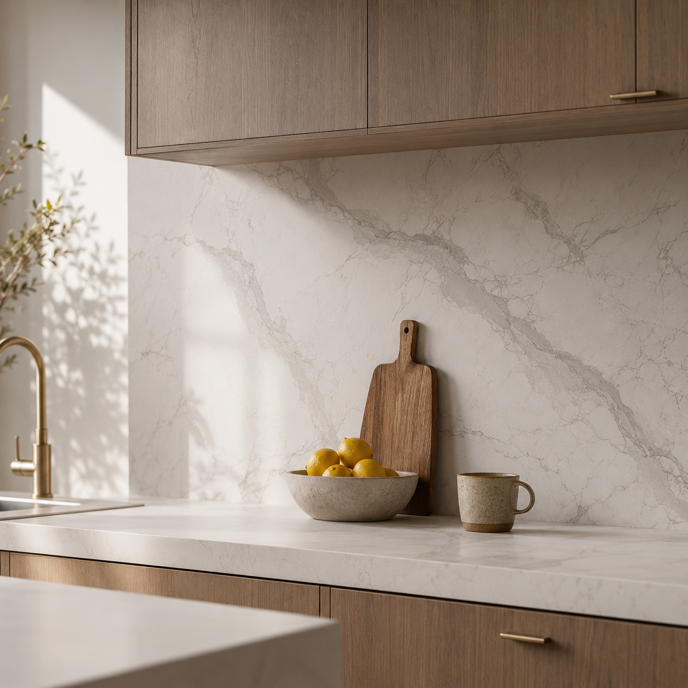
A full-height slab backsplash is one of the strongest kitchen ideas right now. Current backsplash trends favor highly graphic, full-slab stone treatments with continuous movement rather than patterns broken into smaller pieces. You can translate that into marble-look porcelain by running a large panel from counter to upper cabinet or ceiling, with the fewest practical joints, so a Calacatta or Nero vein reads as a single architectural gesture. It gives you the slab look with porcelain's easier upkeep. Start with our backsplash tile selection.
Go dramatic with a continuous-vein waterfall island
Architectural Digest lists porcelain as a suitable material for a waterfall counter, and designers note that matching veins across the horizontal top and the vertical drop can be more predictable with a manufactured surface than with unpredictable natural stone. Our Magnifica porcelain slab line is built for exactly this kind of work. It is a marble-inspired, large-format porcelain slab available in sizes up to 120×60, in colorways including Statuarietto Polished and ERA, which lets a single vein pattern carry across the top and down one or both island ends. A Calacatta-style look suits the showpiece version, while Carrara or Statuario gives a quieter monolith. A waterfall treatment is not a shortcut on budget, since it adds material and fabrication labor, so plan for that.
Ground the kitchen with a large-format marble-look floor
Large-format tile gives long veins room to read and reduces the amount of visible grout, which helps a floor feel more like continuous stone. Carrara or Statuario looks tend to work best underfoot because their lower contrast reads as calm rather than busy. When you shop a floor, look at the visible abrasion class, often called a PEI rating, which is tested under ASTM C1027 for glazed tile. Class III is a reasonable starting point for a residential kitchen, and Class IV is the more conservative choice for a busy household. Always confirm the specific product is approved for floor use rather than choosing by a general number alone. See our large format tile options for open-plan kitchens.
Add movement with subway, herringbone, or mosaic
Not every marble-look kitchen needs a monolithic slab. A few smaller-scale options:
A Carrara-look subway backsplash with near-tonal grout gives the most classic result.
A Statuario or Calacatta herringbone adds more movement in a smaller area.
A marble-look mosaic can form an inset over the range or a short accent band.
A dark Nero-look subway makes the backsplash graphic without committing to a full black slab.
One tip on grout is that tonal grout preserves the continuous marble effect, while high-contrast grout turns the layout into a deliberate graphic element, so choose based on the effect you want.
For color pairings, current kitchen design leans toward warm neutrals and natural wood rather than all-white rooms. Carrara pairs well with oak or walnut, Calacatta with warm neutral cabinets, Statuario with green or blue cabinetry, and Nero Marquina with pale cabinetry, walnut, and brass. Explore more ideas on our kitchen tile page.
Best marble-look porcelain ideas for bathrooms
Wrap the whole bathroom in one marble look
Using one material across floors and walls, sometimes called material drenching, is a strong current bathroom direction, and marble-look porcelain is well suited to it. The material can give floors and walls a coordinated marble appearance while avoiding marble's acid sensitivity and sealing burden. You do not need the same finish on every surface. A polished wall paired with a properly wet-rated matte or honed floor keeps the look continuous while adding traction underfoot. Carrara gives calm continuity, and Calacatta reads as deliberate luxury. Our bathroom tile collection is a good place to start.
Make a statement with large-format shower walls
Vertical surfaces are the most straightforward place to use large-format panels, because they minimize visible joints and preserve large-scale veining. A floor-to-ceiling marble-look panel can make a shower feel like carved stone. This is the easier of the two shower applications, since walls do not carry the drainage requirements a floor does. Browse shower tile for wall and floor options.
Carry the look through a curbless shower floor, with planning

Curbless showers are a genuine design direction for their open, barrier-free look, and carrying a marble-look tile through the floor can make the whole room feel larger. Shower floors need more care than walls. The floor has to slope toward the drain, and larger tiles require more cutting and planning to follow that slope, while smaller tiles conform more easily. Tile is also not the waterproofing on its own; a shower needs a complete waterproof assembly under the tile. Bedrosians does not install tile, but your local showroom can connect you with a trusted contractor to handle the drainage, slope, and waterproofing correctly.
Use niches and mosaics to change scale
A recessed niche is a good place to shift scale without changing marble family. You can continue the same large tile through the niche for a minimal, monolithic look, rotate the vein direction on the niche back for subtle differentiation, or switch to a matching marble-look mosaic to make it a controlled accent. Small-format mosaics also solve two problems on shower floors: they establish scale contrast against large wall tile, and their extra grout joints help make a sloped floor visually intentional. The product still needs the right wet-floor rating, which grout lines do not replace.
Designer Nicole Salceda of Eye for Pretty used 12×24 marble-look porcelain in the Rutherford Residence, a good example of how a mid-scale marble-look format reads in a real bathroom. For classic small-format ideas, our Antica Roma porcelain is a 12×12 marble-look tile that suits traditional floor and wall layouts. If you are still weighing materials for a full remodel, our guide to choosing between porcelain, ceramic, and stone for a bathroom remodel covers the trade-offs.
How to choose the right finish for floors versus walls
Finish is a design choice and a safety consideration, and the two rooms handle it differently.
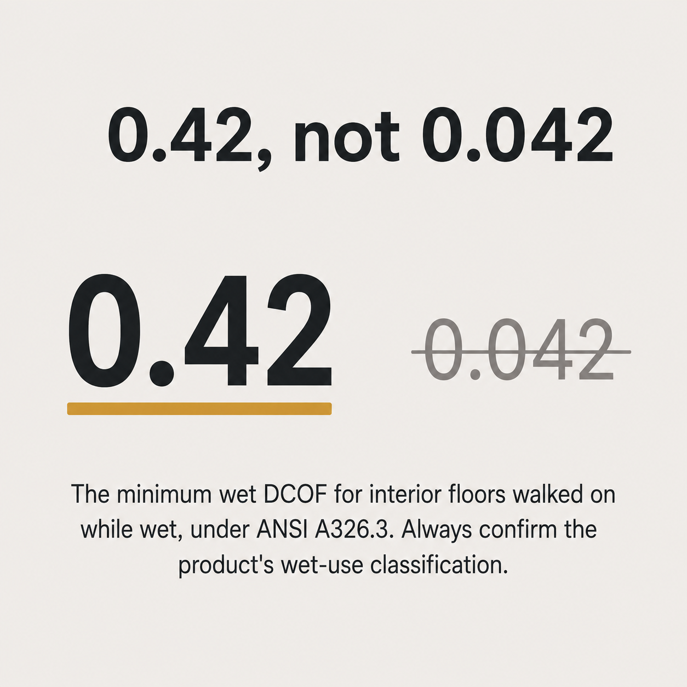
For wet floors, matte, honed, or textured porcelain is the sensible starting point, because polished surfaces are generally more slippery when wet. The Tile Council of North America points to 0.42 wet dynamic coefficient of friction (DCOF) as the key benchmark under ANSI A326.3 for level interior floors walked on while wet. That figure is 0.42, not 0.042, which is a common error in other guides. The current standard is more nuanced than a single number, though, so also check the product's A326.3 use classification and the manufacturer's declared suitability for your specific application. Finish alone does not prove slip resistance.
For walls, backsplashes, and other surfaces you do not walk on, a polished finish is on the table and can maximize the stone-like sheen that makes marble-look porcelain convincing.
A simple way to decide:
Wet floor (bathroom, shower, kitchen prone to spills): start with matte or honed, then verify the product's wet-use classification.
Wall, backsplash, or shower wall: polished is fine and often preferable for the sheen.
Curbless shower floor: matte or small-format, with professional planning for slope and drainage.
What marble-look porcelain costs
As a general planning guide, national material estimates from Angi, updated in August 2026, put porcelain tile at roughly $3 to $10 per square foot and natural marble tile at roughly $5 to $25 per square foot. That points to a typical price advantage for porcelain, but it is not a guaranteed saving on every project.
Material | General material estimate (per sq ft) |
Ceramic tile | $0.50 to $7 |
Porcelain tile | $3 to $10 |
Marble tile | $5 to $25 |
Natural stone | $5 to $35 |
Marble-look porcelain specifically runs from about $3 to $30 per square foot depending on the collection, format, and finish, according to Angi's porcelain tile guide, so it is better described as accessible-to-premium than as a budget material. Large formats, slabs, and sophisticated marble looks sit at the higher end. Porcelain slab countertops and waterfall work are a separate price category again.
Porcelain rarely delivers a fixed percentage saving over marble. What you get instead is the marble aesthetic, lower maintenance, and often a lower material cost, without the etching and sealing that come with the real stone. That is the affordable-luxury logic behind our in-house collections.
If a marble-look countertop is part of the project, our porcelain slab option is Magnifica, and our engineered mineral surface line is Nouvel, available in marble-inspired colorways. For the tile ideas in this guide, keep the focus on porcelain floors, walls, and backsplashes.
Frequently asked questions
Is marble-look porcelain good for shower floors?
It can be, with the right product. Choose a matte or small-format tile with a wet-use classification suitable for the application under ANSI A326.3, and have the slope, drain, and waterproofing installed professionally.
Does marble-look porcelain need to be sealed?
Porcelain tile generally does not require sealing. The grout is a separate consideration, since cementitious grout is porous and may benefit from a grout sealer depending on the type used.
Can I use the same marble-look tile on my floor and walls?
Often yes, but confirm the tile is rated for floor use and consider a matte or honed finish for the floor even if you use a polished version on the walls.
Which marble look is the most timeless?
Carrara tends to be the most flexible over time because its soft, low-contrast veining reads as calm and pairs easily with warm woods and changing color palettes. Calacatta and Nero Marquina make bolder statements that commit the room to a stronger look.
Bring the marble look home
If you are planning a kitchen or bathroom, the fastest way to make a confident choice is to see the tile in your own lighting. We offer samples so you can compare a Carrara, Calacatta, Statuario, or Nero Marquina look against your cabinets and floors before you buy. Order tile samples online, browse our porcelain and marble-look collections, or call us at (559) 275-5000 to connect with a showroom near you. If your project needs installation, we will point you to a trusted local contractor.

