Porcelain Slab Cost in 2026: A Complete Buyer's Guide
October 6, 2026
A porcelain slab usually costs about $20 to $65 per square foot for the material itself, and roughly $50 to $120 per square foot once it is professionally fabricated and installed. Most straightforward countertop projects land in a narrower $50 to $70 per square foot range. A single "porcelain slab cost" number is hard to pin down because it rolls three separate costs into one: the slab, the fabrication, and the installation. The slab is often the most affordable part, and the fabrication and installation, both handled by a qualified contractor, are where most of the variation lives.
At Bedrosians Tile & Stone, we supply porcelain slabs and stock the setting materials, tools, and grout installers needed
at our showroom pro counters. We have been in the tile and stone business for 78 years, with 44 showrooms across 11 states and slab yards for larger stone and porcelain pieces. The prices in this guide are general market estimates, not Bedrosians pricing. Actual costs vary by region, material and finish, fabrication, and project size, so use these ranges to plan a budget and then get a quote for your specific project.
What does a porcelain slab cost in 2026?
For the material alone, current national cost guides put porcelain slabs at roughly $20 to $65 per square foot. Once you add professional fabrication and installation, a finished porcelain countertop is better budgeted at about $50 to $120 per square foot. The tighter $50 to $70 per square foot band is a useful sanity check for a standard project. The wider figure covers thicker slabs, detailed edges, multiple cutouts, difficult access, or higher-priced material.
Cost stage | Typical 2026 range | What it covers |
Material (slab only) | $20–$65 per sq ft | The porcelain slab before any shop work |
On-site installation labor | $10–$20 per sq ft | Setting labor, reported separately by some guides |
Fabrication and installation (bundled) | $30–$60 per sq ft | Templating, edge work, cutouts, and setting, often quoted together |
Finished countertop (installed) | $50–$120 per sq ft | Slab plus fabrication and installation, with $50–$70 as the common average |
Treat these as planning bands rather than a firm quote. Different cost guides define "slab," "labor," and "installation" differently, so the totals only become comparable once you see the line items on your own estimate.
The three parts of a porcelain slab quote
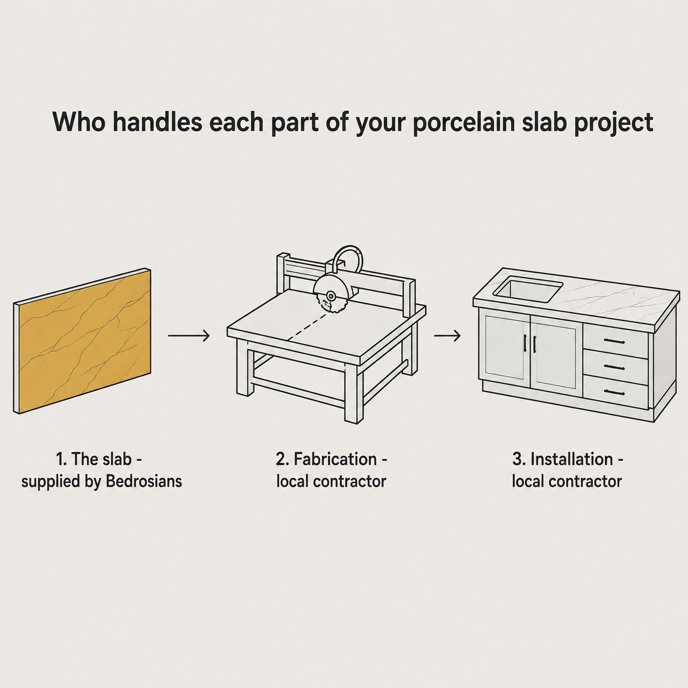
Every porcelain slab quote breaks into three buckets. Keeping them separate is the single most useful thing you can do when comparing prices.
The slab (material)
This is the porcelain slab itself, and it is the part we supply. Material runs about $20 to $65 per square foot depending on the collection, thickness, size, and finish. At Bedrosians, you can compare porcelain slabs and other stone options at our slab yards and order samples before you commit.
Fabrication
Fabrication is the shop work that turns a raw slab into a finished piece: templating, cutting to size, edge profiling, and cutting the openings for sinks and cooktops. It is performed by a qualified fabricator or contractor, not by Bedrosians. Neutral national sources do not publish a clean porcelain-only fabrication rate on its own, because it is almost always quoted together with templating, edges, cutouts, and delivery.
Installation
Installation is the job-site labor that sets and secures the finished slab. Some cost guides report on-site installation labor at about $10 to $20 per square foot, while others bundle it with fabrication at $30 to $60 per square foot. When you need installation, we refer you to trusted local contractors, and our pro counters stock the thinset, grout, and tools they use.
There is no reliable universal split between these three buckets, so ask your contractor to itemize the slab, the fabrication, and the installation on your quote instead of accepting one blended per square foot number.
Why porcelain fabrication costs so much
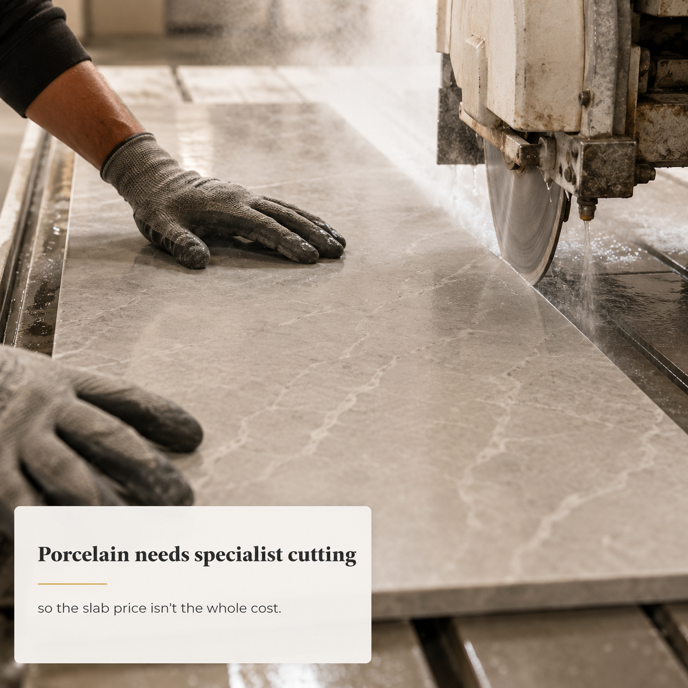
An affordable slab can still produce an expensive installed countertop, and the reason is fabrication. Fired porcelain can hold internal tension and carries a real risk of chipping or cracking while it is being cut, polished, and moved. Trade sources note that fabricators use porcelain-specific blades, controlled cutting speeds, flat and level work surfaces, and, in some cases, non-contact waterjet cutting to work large pieces without cracking them. That specialized labor is why porcelain fabrication is priced differently from cutting conventional stone, and why the service side of a quote can rival or exceed the price of the slab.
Cost drivers you control
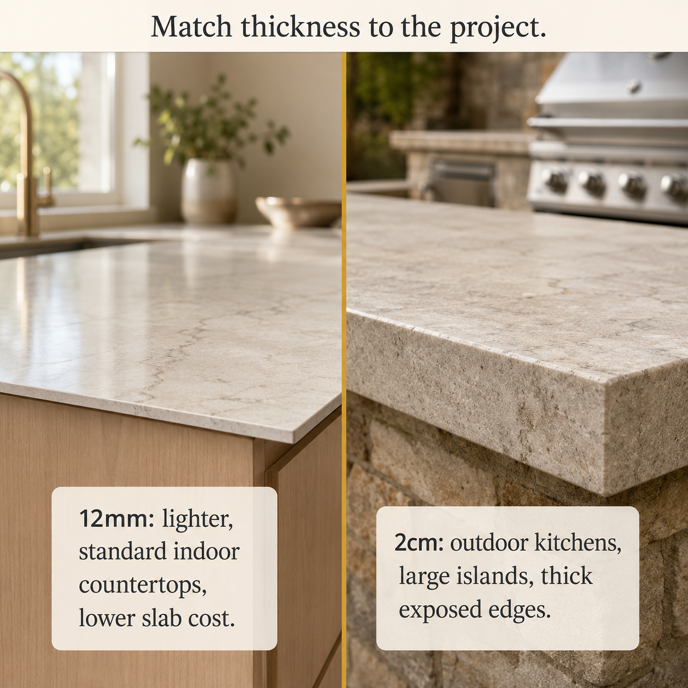
Much of the spread in porcelain slab cost comes down to choices you make. These are the levers that move the number the most.
Thickness: 12mm vs 2cm
Thickness is a genuine decision point, and it affects both the slab price and the fabrication. A 12mm slab is the lighter, lower-cost option, at roughly 6 to 8 pounds per square foot by our estimates. A 2cm slab is heavier and stronger, around 9 to 11 pounds per square foot, and it suits outdoor kitchens, large islands, generous overhangs, and thick exposed edges.
Thickness affects more than the slab price, so weigh it as a system decision. A 12mm slab that needs a chunky edge may require a mitered buildup, which we estimate at about $20 to $90 per linear foot. A 2cm slab can sometimes take a simpler exposed edge instead. For a full breakdown, see our guide to choosing porcelain slab thickness.
Edge profile
The edge you choose is one of the clearest line items on a fabrication quote.
Edge style | Typical added cost |
Square or eased | No additional charge |
Bevel or bullnose | $10–$12 per linear foot |
Built edge | $15–$25 per linear foot |
Mitered edge on 12mm (our estimate) | $20–$90 per linear foot |
Choosing a standard eased or square edge is one of the easiest ways to keep fabrication cost down.
Cutouts
Each opening for a sink, cooktop, or faucet typically adds about $100 to $200. Cutouts are technically sensitive spots where fabricators cut carefully to avoid cracks, so fewer openings usually mean lower fabrication cost.
Finish
Finish pricing is not consistent across the market. Some sources show polished slightly higher than unpolished, and others show the opposite. Treat finish as a product-specific cost that depends on the collection and manufacturer rather than a fixed premium.
Slab size and seams
Larger slab formats can reduce or eliminate seams, which is part of the appeal of a big, continuous porcelain surface. Larger pieces also make transport, site access, handling, and a flat substrate more important, and they can call for a bigger crew. Bigger is not automatically cheaper, so weigh the seamless look against the handling requirements.
Site costs beyond the slab
A realistic budget includes work that sits outside the slab and fabrication line.
Site item | Typical range | Notes |
Old countertop removal and disposal | $50–$300 | May already be included in a contractor's quote |
Kitchen remodel permits | $50–$500 | A simple like-for-like replacement often needs none |
Floor leveling and prep (floor tile) | $2–$30 per sq ft | Standard tile site prep, not slab-specific |
Subfloor repair (floor tile) | $2–$10 per sq ft | Depends on existing condition |
Before you compare two quotes, check whether templating, delivery, tear-out, substrate work, appliance or plumbing disconnection, and permits sit inside or outside the per square foot price.
Cost by application: countertops, floors, and walls
Most porcelain slab cost data covers countertops. Other applications have less clean national pricing, so treat these as looser guidance.
Application | Planning benchmark | Notes |
Countertop | $50–$120 per sq ft installed | The best-documented use |
Flooring | $15–$50 per sq ft installed | Based on standard porcelain floor tile, not large slabs; big slabs can need more prep and handling |
Backsplash | $15–$40 per sq ft installed | General backsplash figure, not slab-specific |
Wall, shower, or fireplace cladding | No reliable national range | Highly sensitive to wall prep, panel handling, and cutouts |
Outdoor countertop | Start from the countertop range | Exterior substrate and climate can change installation |
How much does a porcelain countertop cost by kitchen size?
For a typical 30 to 50 square foot kitchen, it helps to plan with two bands: the common $50 to $70 per square foot average and the broader $50 to $120 per square foot range for more involved work. The totals below are calculated from those per square foot ranges, not from separate survey data.
Countertop area | Common average ($50–$70) | Broader range ($50–$120) |
30 sq ft | $1,500–$2,100 | $1,500–$3,600 |
40 sq ft | $2,000–$2,800 | $2,000–$4,800 |
50 sq ft | $2,500–$3,500 | $2,500–$6,000 |
Use the common average to sanity-check whether a quote sits in the normal neighborhood, and lean toward the broader range if you are choosing mitered edges, several cutouts, difficult access, or higher-priced slabs.
Porcelain vs quartz, granite, marble, and quartzite
Porcelain's material price can undercut many other slabs, but the installed price overlaps heavily once specialized fabrication is included. Porcelain is not automatically the cheapest finished countertop. A low material price does not guarantee a low finished price, so compare the installed totals when you shop.
Surface | Material range | Installed range |
Porcelain slab | $20–$65 per sq ft | $50–$120 per sq ft |
Engineered quartz | $40–$170 per sq ft | $50–$200 per sq ft |
Granite | $40–$100 per sq ft | $80–$150 per sq ft |
Marble | $40–$100+ per sq ft | $40–$150 per sq ft |
Quartzite | Varies by stone | $65–$150 per sq ft |
The honest takeaway is that porcelain gives you a large-format, natural-stone look at an accessible material price, with the finished cost depending heavily on fabrication. Alongside porcelain slabs, we also carry Nouvel mineral surface slabs in 2cm and 3cm, plus natural stone slabs including granite and quartzite. If you are weighing materials, our comparisons of porcelain countertops versus quartz and granite and porcelain versus natural stone go deeper on durability and long-term cost.
Does a porcelain slab need sealing?
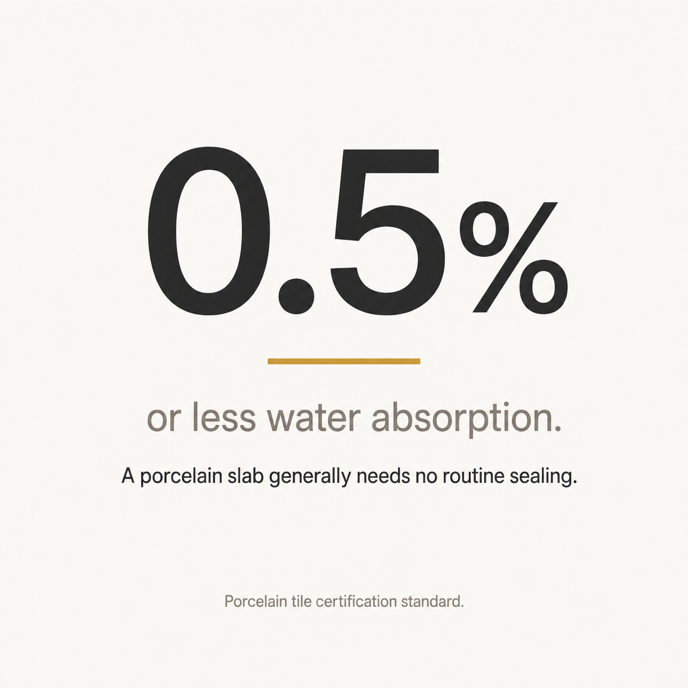
A porcelain slab generally does not need routine sealing, which is part of its long-term cost advantage. Porcelain is classified as impervious, with water absorption of 0.5% or less, so the surface resists moisture and stains without a periodic sealer.
There are two caveats. Some polished or honed finishes call for a grout release or sealer during installation, and grout has its own care requirements, so always follow the instructions for your specific slab. Compared with many natural stones, this is still a real maintenance savings. The Natural Stone Institute notes that many marble and granite counters benefit from sealing with a quality sealer that can last 10 to 15 years, so the gap is real but smaller than the common "seal every year" claim suggests. Engineered quartz also generally skips routine sealing, so porcelain's edge here is strongest against natural stone.
How to budget for your project
Here is a simple way to plan your budget.
Start with the ranges above. Use $50 to $70 per square foot as a first-pass countertop estimate, and $50 to $120 for more complex work.
Get an itemized quote. Ask your contractor to break out the slab, fabrication, and installation, plus edges, cutouts, tear-out, and delivery.
Control the fabrication levers. A standard eased edge and fewer cutouts keep costs down. A mitered edge and multiple openings add up.
Match thickness to the project. Choose 12mm for lighter, lower-cost surfaces and 2cm where you need strength or a thick edge. Our slab buying guide walks through the decision.
Sample before you buy. Order samples and see the color and finish in your own lighting before committing to a full slab.
For the countertop category, our flagship is the Magnifica porcelain slab, available in 12mm and 2cm thicknesses and large-format sizes up to 120x60. It is GreenGuard certified and backed by a 10-year limited warranty, with select colorways made in the USA. Bedrosians says Magnifica became the first 2cm porcelain slab manufactured in the United States when it launched in 2019.
Frequently asked questions
Is a porcelain slab cheaper than quartz or granite?
The porcelain slab material often costs less, but installed prices overlap because porcelain fabrication is specialized. Compare finished, installed totals rather than material alone.
How thick should a porcelain countertop be?
A 12mm slab suits most standard countertops and costs less, while 2cm suits islands, overhangs, outdoor kitchens, and thick exposed edges.
What adds the most to porcelain slab cost?
Fabrication and installation add the most, followed by buyer choices like mitered edges, extra cutouts, and difficult site access.
See porcelain slabs in person
The best way to nail down your budget is to see the slab and get a real quote. Order tiles to check color and finish in your own space, or visit a Bedrosians slab yard or showroom to compare porcelain slabs, Magnifica, and natural stone side by side. Our team can help you find the right slab for your project and connect you with a trusted local contractor for fabrication and installation. Call us at (559) 275-5000 or reach out through our contact page to get started.

